

2026: A Turning Point for Chronic Respiratory Health in Europe
Featuring contributions from:
Susanna Palkonen (Director at the European Federation of Allergy and Airways Diseases Patients Associations (EFA))
Dr. Ricardo Baptista Leite (CEO of HealthAI – Founder & President of ‘UNITE Parliamentarians Network for Global Health’)

When respiratory health is discussed in Europe, the numbers are often the first thing people reach for – and with good reason.
Chronic respiratory diseases (CRDs) affect 81.7 million people in the 53 countries of the WHO European Region. Chronic obstructive pulmonary disease (COPD) – one of the most prevalent CRDs alongside asthma – affects over 38 million people, and is responsible for nearly 80% of CRD deaths in the WHO European Region.
Figures like these clearly show the challenge, but they can also mask the progress that has been made, and the opportunities that are now within reach.
81.7 million
People living with chronic respiratory diseases in the 53 countries of the WHO European Region
38 million+
People living with COPD – responsible for nearly 80% of CRD deaths in the region
In 2026, there is clearer agreement on the importance of prevention (The Unseen Future of Nicotine) and earlier diagnosis (How the GP Practice Can Stop a Global Health Crisis); treatment options have improved; pulmonary rehabilitation and longer-term support are better established; and a proposed Council Recommendation acknowledges the importance of respiratory health for cardiovascular health and includes respiratory function as a component of recommended heart checks. We’re also seeing action across Europe, where countries are testing different ways of bringing these elements together through primary care, national strategies, patient registries and community-based services.
And yet – because there always has to be an “and yet” – progress remains patchy in 2026, but it’s not all bad.
Work at country level is giving us the blueprint of what needs doing, setting the foundation needed for a true turning point and helping us focus on the “how”: how to build on what is already working, how to learn across different health systems, and how to ensure that the benefits of better respiratory care reach more people.
That question becomes particularly pressing as the 2030 global targets approach. Europe has made progress, but targets achieved in aggregate can conceal wide differences in how – and when – patients receive care.
There is a next phase that depends less on another statement of clinical intent and more on the ordinary workings of health systems, and asking the questions needed to get us there.
Does a local practice have the equipment to test a patient’s lungs? Can a diagnosis open a pathway to treatment and rehabilitation? Can a clinician see where care is breaking down? That depends on data being collected consistently enough to show not only how many people are diagnosed, but where patients are lost between testing, treatment and longer-term support.
And of course, that needs resources.
Investing in what works
While the pathway may feel clinical, the ability to open doors is inherently financial. These decisions determine where costs accumulate – and where earlier action can make the greatest difference. Respiratory diseases receive around €10.5 million out of the €4.4 billion budget of the EU4Health programme, which represents just over 0.2%¹. These figures are dwarfed by the estimated €380 billion annual cost of care in the EU identified in a 2019 study, consisting of at least €55 billion in inpatient health care, €42 billion in lost productivity and €280 billion in the monetised value of disability-adjusted life-years (DALYs).
We’re past proving whether respiratory health deserves more investment, we know it does – but even the strongest supporters of this argument understand that we need to make it clear to policymakers what investment could make possible.
So, let’s look at local data.
A Spanish social-return analysis, published in 2022, examined 15 proposals for improving COPD management. It found that an investment of €668 million could generate €2.079 billion in social impact over a year – over €3 for every euro spent.
€668 million
Investment across 15 proposals for improving COPD management in Spain
€2.079 billion
Social impact it could generate over a year – over €3 for every euro spent
The study is valuable not because it settles every budget decision – no single analysis could – but because it gives shape to an otherwise abstract debate.
Spending on COPD can mean earlier diagnosis, more organised follow-up, pulmonary rehabilitation and support that helps people manage their condition before it becomes an emergency. These are not futuristic concepts; they are the necessary work of diagnosis and treatment which begin with a basic lung-function test in primary care and a clear understanding of what should follow it.
Counterintuitive as it sounds, spending on COPD now actually means less spending in the long run. Fewer exacerbations, fewer people hospitalized, less absenteeism and significant intangible social returns.
¹ This represents the total budget allocated to all diseases of the respiratory system based on the European Commission’s published data on the EU4Health funded projects. Source: EU Funding & Tenders Portal.
How earlier diagnosis builds stronger pathways
Effective respiratory care is driven by smart, coordinated clinical policy and structured patient pathways, not just by how wealthy a health system is.
By equipping primary health facilities with basic diagnostic tools (like spirometers), incentivising lung health checks amongst other vital signs like heartbeat, and utilising clinician-managed registries, we can make massive changes at the patient level. These get people diagnosed.
At present, the European Federation of Allergy and Airways Diseases estimates that around 70% of COPD cases may be undiagnosed, with further fluctuation depending on the setting and the study. Behind those figures are people whose breathlessness, persistent cough or fatigue may be written off as age, a history of smoking or poor fitness, sometimes until a serious deterioration brings them to hospital.
Spirometry – the test used to confirm COPD – has been standard equipment for decades. Yet it is not consistently available in the primary care settings where early diagnosis is most likely to change the course of disease.
There are, however, encouraging examples of wider access, like in the Netherlands, where 85% of primary care practices performed spirometry.
But does access always equate to use? Unfortunately, not. Take Sweden, for example, where one study reported spirometers were available at 99% of primary health care clinics and at all outpatient clinics, but had only been used to check lung function in 52% of COPD patients in primary care and 89% in outpatient clinics.
Neither country offers a model that can be copied without adjustment, but they do show that consistent access to diagnostic testing is not beyond reach if health systems are properly organised around it.
But then what?
As previously discussed in the article “How the GP Practice Can Stop a Global Health Crisis” – initial testing is one thing, but there is also the need for confidence to use and interpret results; the need to ensure patients have somewhere to go after diagnosis; and the need for supporting primary care teams in remaining involved as the condition is managed over time.
And that requires a look at the wider chain in action.
Policy and coordination
The difference between access to healthcare and access to a coherent care pathway is particularly clear in Spain and Germany.
Both countries are large, prosperous and have universal healthcare systems. In the 2025 COPD Index, they are almost indistinguishable on Access and Care Coverage: Spain scores 75.6 and Germany 75.2. Yet Spain ranks 10th overall in the Index among the 45 countries assessed, while Germany ranks 31st.
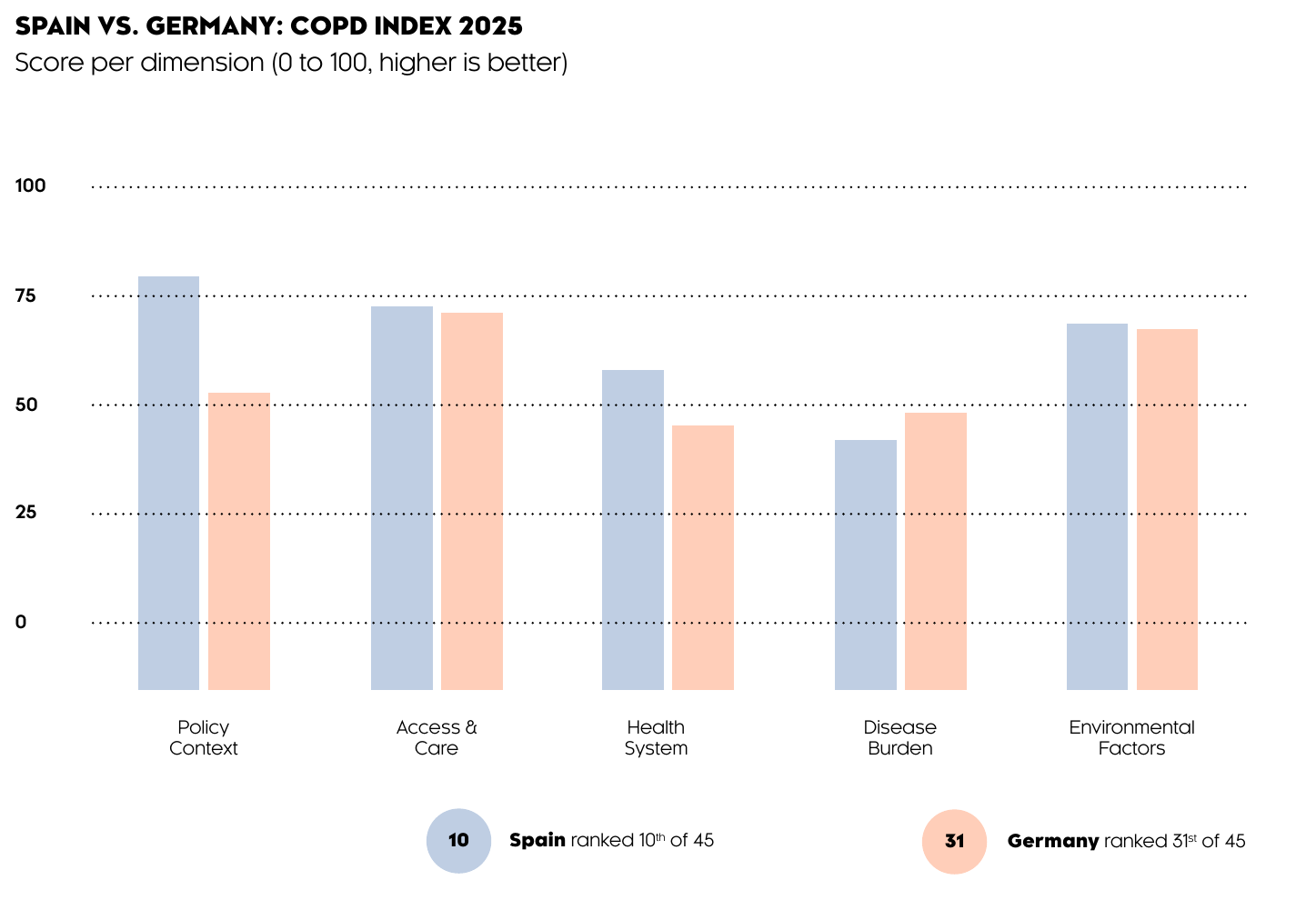
Access & Care coverage scores are nearly identical (75.6 vs. 75.2), yet Spain ranks 21 places higher. The gap is policy: Spain has a national COPD strategy and clinical guidelines. Germany has neither.
The gap is not caused by money, or coverage. It’s one of policy groundwork and low annual hospitalisation and readmission rates for COPD.
Spain has a formal national COPD strategy and national care guidelines with more established adherence across the system. Germany has no national COPD strategy and more limited, regional guidance.
Spain scores two out of four for its national strategy and three out of four for guideline adherence; Germany scores zero and one respectively.
For a patient, integrated care can be the difference between a diagnosis that leads somewhere and one that does not. Earlier identification should lead to structured long-term management, appropriate treatment, pulmonary rehabilitation where needed and access to advanced therapies. Community health workers can help people stay connected to care and manage their condition at home. Shared protocols and clinician-managed registries can reduce the risk of a patient being passed between primary care, specialists and emergency departments without continuity.
And while no index can capture the full reality of either health system, and neither country has solved every aspect of COPD care, the comparison suggests that universal access, important as it is, does not automatically produce a coherent respiratory pathway or better outcomes for patients.
Ireland case study: turning plans into delivery
The question, then, is what this looks like once policy begins to shape the everyday delivery of care – so let’s look at Ireland.
Ranked 15th of 45 countries in the 2025 COPD Index, but fourth for Access and Care Coverage, Ireland has strong provision for diagnostics, pulmonary rehabilitation and ambulatory oxygen.
That matters in a country with one of the OECD’s highest rates of hospital admission for COPD exacerbations, and an estimated 500,000 people over 40 living with COPD, roughly half of them undiagnosed.
The response has been to move more care closer to home. Ireland now has 30 hub-based respiratory teams, with 295 staff, linking Specialist Ambulatory Care Hubs, community respiratory services, COPD outreach, pulmonary rehabilitation and direct GP access to spirometry.
Between 2019 and 2023, the wider Enhanced Community Care programme reported a 15% fall in admissions among people with chronic disease, compared with 1.3% across medical admissions overall. The figure is not COPD-specific, nor can it be credited to one move, but it does suggest what can happen when care no longer depends so heavily on the hospital door.
The results are promising, but they also raise the questions policymakers will ask next: what did this model cost, which parts depended on Ireland’s particular health-system context, and which could be adapted elsewhere? Evidence of improvement is essential; so is a clear account of affordability and feasibility.
Ireland still has no national COPD registry, a gap that will matter as these services grow, but let’s not let that take away from the success we see here. Taking a step back, Ireland is beginning to show how clinical leadership, community capacity and practical use of data can make respiratory care more dependable in everyday life.
This is another example of an imperfect system akin to the ones we have already seen so far. The difference, however, is Ireland’s unique position within policymaking as the current president of the Council of the European Union. Ireland’s EU Presidency in the second half of 2026, followed by Lithuania and Greece in 2027, creates an 18-month window in which respiratory health could remain in view.
The opportunity is not to hold another conversation about what good care looks like. It is to give countries time to compare what they are learning, and to carry the most useful lessons into everyday practice.
And to do so within a European framework.
Turning national progress into European action
After a few years where CRDs were recognized and met with commitments on the policy agenda, the next 18 months offer an opportunity to turn national lessons into sustained European conversation, a window to advance chronic respiratory health on the policy agenda and connect national progress with shared European goals.
2027 could well be the period when we start the ball rolling in translating targets into actionable policy.
We know what good care looks like, now it is time to give countries the time and structure to compare what they are learning, identify what can be adapted in different settings and carry the most useful lessons into everyday practice.
A dedicated EU Lung Health Plan could give that work greater continuity, helping countries to learn from one another, identify what is transferable and act on the evidence already available. Patient organisations, clinicians, policymakers and local media all have a role in sustaining that momentum.
The work is already moving. Examples emerging across the region show what can happen when respiratory health is given clearer ownership and the support to follow through.
The question for 2027 is whether those lessons can be translated into more consistent progress for people living with chronic respiratory disease.
Disclaimer: The RHI 2026 Editorial Bureau, and the RHI initiative are supported by unrestricted financial support from Sanofi and Regeneron. The Copenhagen Institute for Futures Studies (CIFS) retains full editorial independence over this article and all related articles published as part of the bureau.
Contact

Adela Bisak
Advisor & Futurist
ab@cifs.dk

Aron Szpisjak
Director, Head of Health
as@cifs.dk